Reaction Kinetics MCQs for MDCAT Practice
Chemistry section, Reaction Kinetics chapter. Sample questions from past PMC papers.
Practice Reaction Kinetics questions from the Chemistry section of MDCAT. The full bank has 854 questions on this chapter, fully explained, with distractor analysis and spaced repetition flashcards. Free with signup.
- Question 1The branch of Chemistry that deals with the reactions rates and reaction mechanism is called:
- A.Chemical Kinetics
- B.Thermodynamics
- C.Photochemistry
- D.Analytical Chemistry
Sign up free to see the explanation, distractor analysis, and add this to your spaced repetition deck. - Question 2The specific rate constant of a chemical reaction is the rate of the reaction when the concentration of the reactant is
- A.Less than unity
- B.Equal to unity
- C.Greater than unity
- D.Equal to the concentration of 2nd order reaction
Sign up free to see the explanation, distractor analysis, and add this to your spaced repetition deck. - Question 3A substance that alters the rate of chemical reaction without being consumed in the reaction is called:
- A.Catalyst
- B.Reactant
- C.Product
- D.Activated complex
Sign up free to see the explanation, distractor analysis, and add this to your spaced repetition deck. - Question 4Which of the following increases the rate of reaction?
- A.Decrease temp
- B.Decrease conc.
- C.Increase surface area
- D.Add inhibitor
Sign up free to see the explanation, distractor analysis, and add this to your spaced repetition deck. - Question 5The sum of all the exponents (power) of the reactants in the rate expression is called:
- A.Molecularity
- B.Atomicity of the molecules
- C.Order of reaction
- D.None of the above
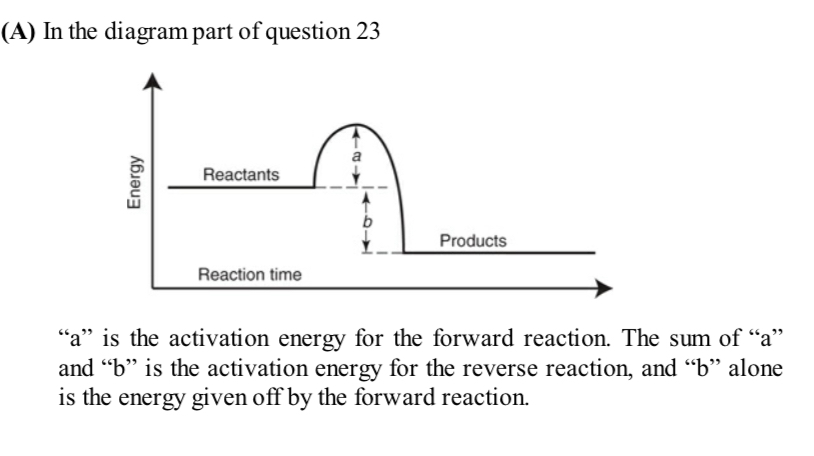
Sign up free to see the explanation, distractor analysis, and add this to your spaced repetition deck. - Question 6If the graphic representation of the energy levels of the reactants and products in a chemical reaction looks like this: Which of the following statements are true? I. The activation energy for the forward reaction is represented by the “a” portion. II. The activation energy for the forward reaction is represented by the “b” portion of the graph. III. The “a” portion is the energy given off in the forward reaction.
- A.II only
- B.I and III only
- C.II and III only
- D.I only
Sign up free to see the explanation, distractor analysis, and add this to your spaced repetition deck. - Question 7What is detailed sequence of steps that leads to the net overall reaction called?
- A.Reaction coordinate
- B.Reaction mechanism
- C.Reaction potential
- D.Reaction rate law
Sign up free to see the explanation, distractor analysis, and add this to your spaced repetition deck. - Question 8In the termination step where two methyl radicals combine to form ethane (CH3. + .CH3 -> C2H6), the reaction typically has an activation energy of approximately zero. What is the logical reason for this?
- A.The entropy of the universe decreases significantly.
- B.There are no bonds to break and two open-shell electrons are pairing.
- C.The reaction is endothermic.
- D.Methyl radicals are stable species that drift together slowly.
Sign up free to see the explanation, distractor analysis, and add this to your spaced repetition deck.
Get the full Reaction Kinetics bank
854 questions with deep explanations, distractor analysis, and curated high-yield selection. Free with signup.
Sign up freeRead the full Reaction Kinetics chapter notes: Reaction Kinetics notes